
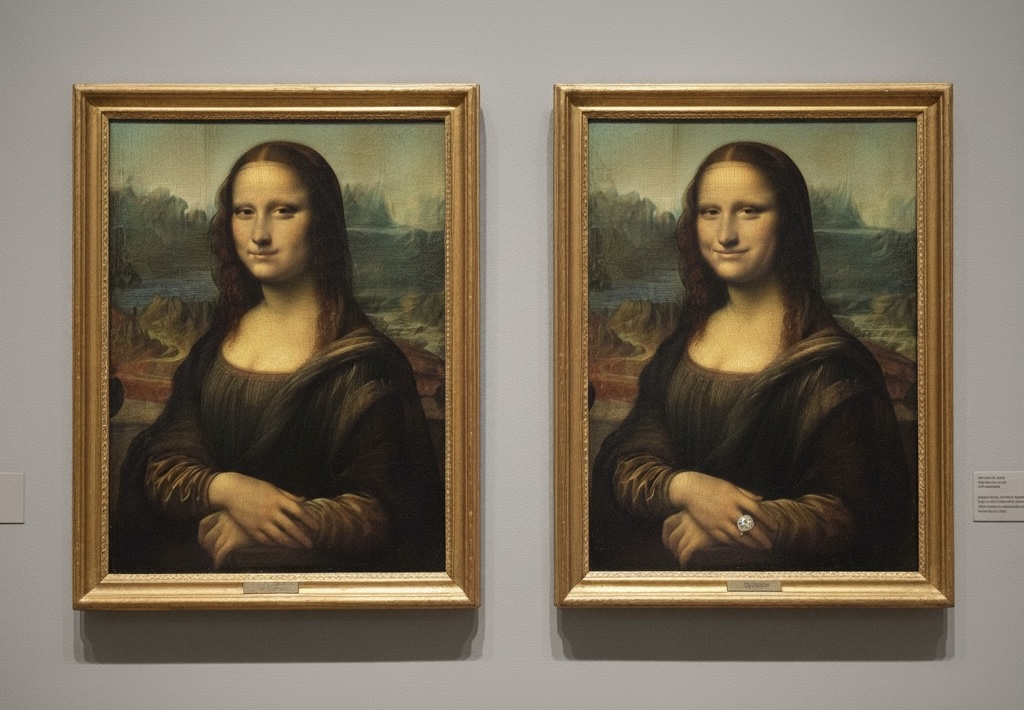
Copies, Clones, and Counterfeits
In a world of perfect fakes, authenticity may become the rarest luxury of all.
The Age of Indistinguishability
That diamond on her finger — is it a billion-year-old miracle pulled from the earth, or a stone born in a lab last month? Without instruments, even an expert’s eye can’t be sure. The same question now shadows the chair in your living room, the photograph in your album, even the video on your screen: Is it real, or just real enough?
From furniture to diamonds, from photographs to videos, we are entering an age where the copies, the clones, and the counterfeits are all but impossible to separate.
Copies: The Harmless Twins
A copy doesn’t pretend to be the original — it acknowledges itself as a reproduction. Copies can have value: prints of famous paintings democratize art; reissues of rare books keep ideas alive; lab-grown diamonds, when presented transparently, give more people access to sparkle without the cost of rarity.
The key to a copy is honesty. Its worth lies not in being unique, but in being accessible.
Clones: The Perfect Replicas
Clones are trickier. They are so close to the original that, to the naked eye, you can’t tell them apart. A lab-grown diamond, seemingly indistinguishable in fire and brilliance from a mined one, is a clone. A 3D-printed chair that looks and feels like an Eames original but isn’t authorized by Herman Miller is a clone.
Clones test our definition of authenticity. If it looks the same, performs the same, and lasts the same — is it less real, or just less rare?
Counterfeits: The Dangerous Deceptions
Counterfeits take the danger one step further. They are not just clones — they are clones passed off as originals. A lab-grown diamond with a fraudulent appraisal inflating its value is counterfeit. A fake Rolex sold as if it left the Geneva factory is counterfeit. A deepfake video, designed to mislead the public into believing something happened when it didn’t, is counterfeit.
Counterfeits matter because they weaponize trust. They don’t just mimic — they deceive.
The Stakes of Confusion
Why does this distinction matter? Because value — whether financial, cultural, or emotional — depends on authenticity. A photograph of your grandmother isn’t priceless because of its pixels, but because of who held the camera. A natural diamond isn’t cherished just for its sparkle, but for the geological miracle of billions of years it embodies.
When we can’t tell the difference between the real and the replica, between the authentic and the artificial, we risk losing more than money. We risk losing meaning.
Navigating the New Reality
The challenge ahead is twofold:
- Detection — developing tools and standards that can verify authenticity in a world of perfect fakes.
- Discernment — deciding, as a culture, what kind of authenticity matters most to us: the origin, the process, the rarity, or simply the experience.
The furniture may hold your weight, the diamond may sparkle, the photo may stir your heart. But knowing what it truly is — that’s where the difference lies.
As copies, clones, and counterfeits grow ever more convincing, the question facing us isn’t just “Can I tell the difference?” but “Does the difference still matter?”
In the end, authenticity may prove to be the ultimate luxury — not because it shines brighter, but because in a world of perfect illusions, it is the one thing that cannot be faked.